
Building a strong technology team is one of the biggest challenges for growing companies. Whether a business is developing enterprise software, managing cloud infrastructure, implementing SAP, or working on cybersecurity projects, having the right people at the right time makes a significant difference.
However, hiring experienced IT professionals is not always easy. Recruitment takes time, salary budgets are increasing, and finding people with specialized technical knowledge can delay important projects.
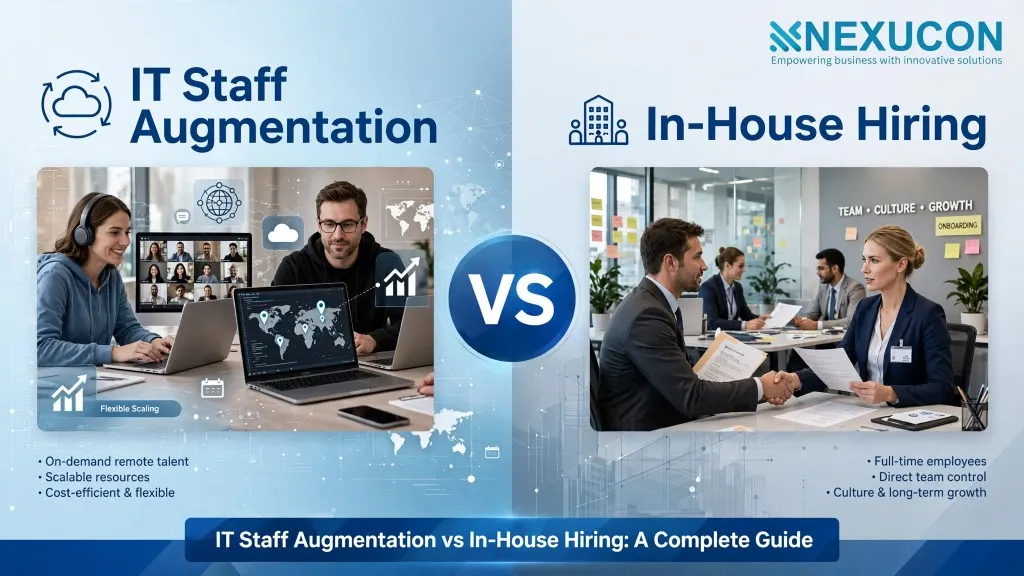
This is where companies need to consider two different approaches: traditional in-house hiring and IT staff augmentation services.
While in-house hiring helps businesses build permanent teams, staff augmentation provides access to skilled professionals whenever additional expertise is required. Both approaches have their advantages, but choosing the right one depends on business goals, project requirements, and available resources.
Let's understand how these hiring models work and which one makes more sense for growing technology companies.
What Is In-House Hiring?
In-house hiring means recruiting full-time employees who become permanent members of your organisation. They work directly under your management, follow company policies, and contribute to long-term business operations.
For example, a software development company planning to maintain its own product may hire permanent Java developers, UI designers, project managers, and quality analysts.
Benefits of in-house hiring:
- Long-term employee commitment and stability.
- Better understanding of company culture and business processes.
- Direct control over employee performance and responsibilities.
- Easier knowledge sharing between permanent team members.
- Suitable for ongoing business operations and core activities.
However, in-house recruitment also involves expenses beyond monthly salaries. Companies need to consider recruitment fees, employee benefits, training, infrastructure, insurance, and retention costs.
For a startup with limited funding, hiring ten permanent developers for a project lasting only six months may not be a practical decision.
What Are IT Staff Augmentation Services?
IT staff augmentation is a hiring approach where businesses bring external technical professionals into their existing teams to meet specific project requirements.
Instead of recruiting permanent employees, companies work with a staffing partner to find professionals with the required technical skills and experience. These professionals work alongside the internal team and follow the project's requirements.
For example, imagine a company is implementing SAP S/4HANA but does not have enough experienced SAP FICO consultants. Rather than spending several months recruiting permanent employees, the company can use IT staff augmentation services to bring experienced consultants into the project.
Key benefits include:
- Faster access to specialized technical professionals.
- Flexibility to increase or reduce team size.
- Lower long-term employment commitments.
- Access to professionals with industry-specific experience.
- Better control over project timelines and resource planning.
A temp staffing solution can also help businesses manage temporary workload increases, employee absences, and short-term project requirements.
IT Staff Augmentation vs In-House Hiring: Key Differences
Both models support business growth, but they work differently.
| Comparison | In-House Hiring | Staff Augmentation |
|---|---|---|
| Hiring process | Traditional recruitment | Staffing partner |
| Employment | Permanent | Contract or project-based |
| Initial cost | Generally higher | Depends on duration and skills |
| Hiring speed | Can take several weeks | Often faster |
| Flexibility | Limited | High |
| Skill availability | Depends on recruitment | Access to wider talent pools |
| Management | Internal management | Client-led project management |
| Best suited for | Long-term operations | Specialized and changing project needs |
The important difference is flexibility. In-house hiring builds a permanent workforce, whereas IT staff augmentation services allow companies to access additional expertise without expanding their permanent employee count.
What Does Industry Research Tell Us About IT Hiring?
The demand for skilled technology professionals continues to create recruitment challenges for businesses.
According to ManpowerGroup's 2025 Global Talent Shortage research, 76% of employers in the IT sector reported difficulty finding skilled talent. The same research highlights cybersecurity, AI, and cloud computing among the most important technology skills.
Another interesting finding comes from SHRM's 2025 Recruiting Benchmarking Report. The report found that the median time required to fill both executive and nonexecutive positions was approximately 45 days.
These findings reveal an important business challenge: companies cannot always wait for traditional recruitment when project deadlines are approaching.
For example, a manufacturing company planning a cloud migration may need cloud architects, DevOps engineers, and cybersecurity specialists within a short period. Using IT staff augmentation services can help the company access the required expertise without waiting for every position to be filled through permanent recruitment.
Research sources: ManpowerGroup Global Talent Shortage Survey 2025 and SHRM Recruiting Benchmarking Report 2025.
When Should Companies Choose Staff Augmentation?
Not every business needs additional permanent employees. Sometimes, bringing external professionals into an existing team is a more practical decision. Here are five situations where staff augmentation makes sense.
1. Short-term project requirements
When a company receives a project with a fixed deadline, it may need additional developers, testers, or technical consultants.
2. Lack of specialized skills
Businesses working on SAP, cloud computing, cybersecurity, or data engineering may require professionals with specific technical experience.
3. Rapid business expansion
When a company wants to expand its development capacity quickly, external professionals can support the existing workforce.
4. Employee shortages
Unexpected resignations, maternity leave, or employee absences can affect project delivery. A temporary staffing arrangement can help maintain productivity.
5. Managing operational costs
Hiring permanent employees for temporary requirements can increase unnecessary expenses. A flexible workforce model helps businesses align staffing costs with actual project needs.
Understanding the Hidden Costs of Both Hiring Models
Salary is only one part of the total employee cost.
With in-house hiring, businesses must also account for recruitment expenses, employee benefits, paid leave, training, equipment, office space, and employee retention.
Staff augmentation has a different cost structure. Companies generally pay an agreed professional rate or service fee, depending on the contract, experience level, and engagement period.
However, it is important to compare the total project cost rather than simply comparing monthly salaries.
Hiring a senior cloud engineer permanently for a four-month migration project may create additional costs after the project ends. Using IT staff augmentation services for the required project period can provide access to expertise without creating a permanent employment commitment.
The best financial decision depends on the duration of work, required skills, and overall project budget.
How to Choose the Right Staffing Partner?
Selecting the right staffing partner is just as important as choosing the hiring model. Before partnering with a provider, businesses should evaluate:
- Technical expertise: Check whether the provider understands your required technologies and job roles.
- Candidate screening: Ask about technical assessments, experience verification, and interview processes.
- Replacement policy: Understand what happens if a professional leaves or does not meet expectations.
- Communication: Ensure the staffing partner provides regular updates and proper coordination.
- Contract flexibility: Check engagement duration, pricing, notice periods, and replacement terms.
- Data security: Confirm confidentiality agreements and access controls for sensitive business information.
A reliable staffing partner should understand your business requirements rather than simply sending available resumes.
The Best Strategy: Combine Both Hiring Models
Growing technology companies do not necessarily need to choose only one hiring approach. A hybrid workforce strategy can provide advantages from both models.
For example, a company can maintain permanent employees for product development, business operations, and technical leadership while using external professionals for temporary projects, specialized skills, and additional development capacity.
This approach creates a stable internal team while allowing the business to respond to changing project demands. IT staff augmentation services can become particularly useful when companies need to scale technical teams without increasing their permanent workforce unnecessarily.
Conclusion
Choosing between in-house hiring and staff augmentation is not simply a recruitment decision. It is a business strategy that directly affects project delivery, operational expenses, and long-term growth.
In-house hiring is suitable for companies that need permanent employees and long-term organizational knowledge. Staff augmentation is a practical option when businesses require specialized skills, faster team expansion, or temporary technical support.
The smartest approach is to understand your business requirements before making a hiring decision.
If your organisation is looking for experienced IT professionals to support software development, SAP implementation, cloud projects, or cybersecurity initiatives, Nexucon can help you explore flexible workforce solutions.
← Back to all articles